In any real estate market, pricing matters. But in today’s Eastside market, the data reveals something sharper than a general principle – there is a measurable cliff between homes that attract an offer in the first week and homes that don’t. The difference isn’t subtle, and it has real dollar consequences for sellers.
I’ve analyzed 433 closed residential sales across the Eastside (NWMLS Areas 500-600) from January 1 through March 20, 2026. When you sort those sales by how long the property was on market before going pending, a striking pattern emerges.
The data, plainly
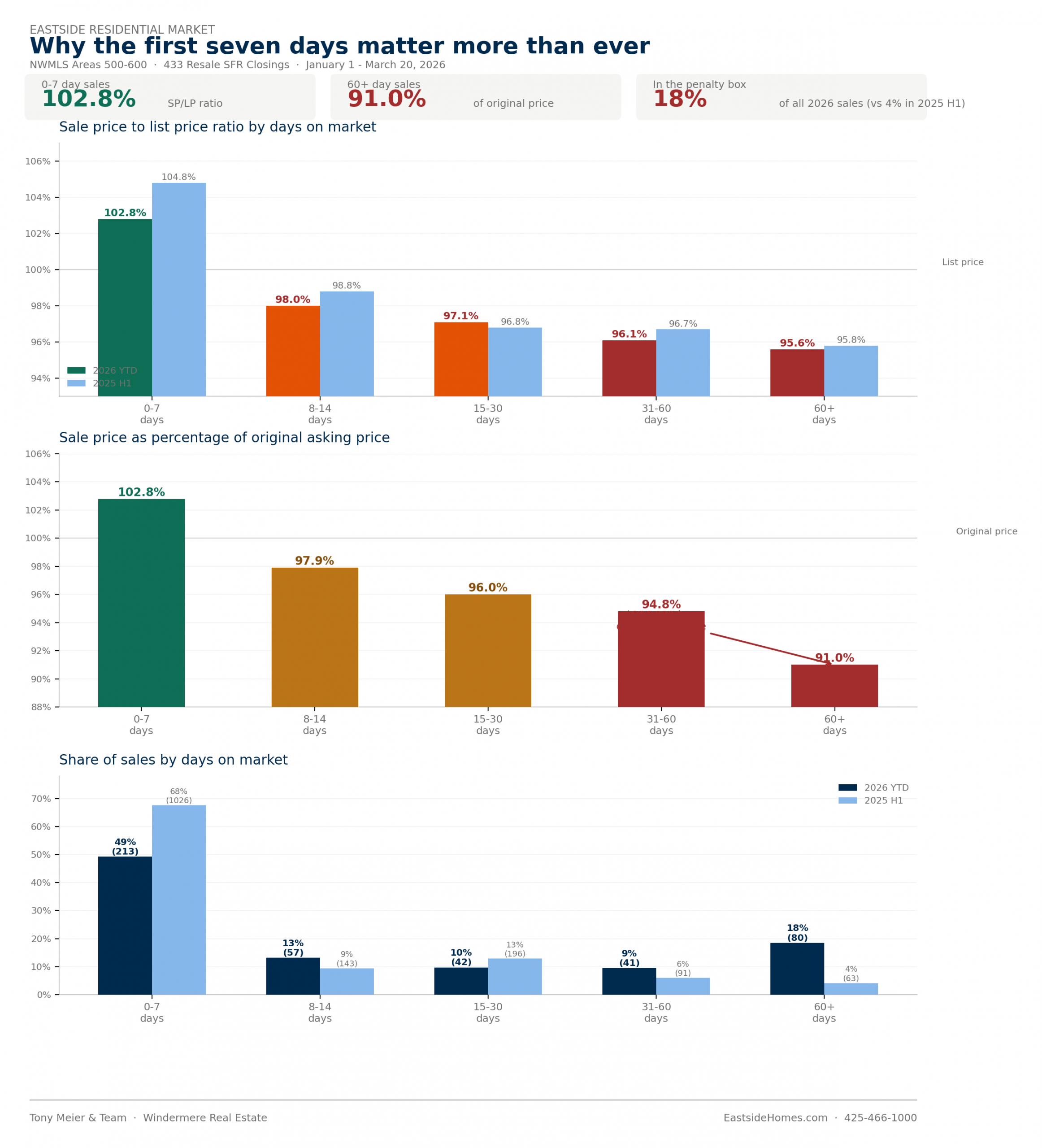
Homes that went pending within the first 7 days sold at an average of 102.8% of list price – meaning they still attracted competitive offers and overbids even in today’s softer market. But the moment a property crosses that first-week threshold without an accepted offer, the outcome changes dramatically.
At 8-14 days on market, the average sale price drops to 98.0% of list. At 15-30 days, 97.1%. At 31-60 days, 96.1%. And homes that sat for 60 or more days sold at just 95.6% of their last listed price – and only 91.0% of their original asking price.
To put that in real terms: a home originally listed at $1,400,000 that sits on market for two months typically closes around $1,274,000. That’s a $126,000 difference in outcome that is almost entirely a function of initial pricing accuracy.
The penalty box is getting crowded
What makes this data particularly relevant right now is how many homes are ending up in that 60+ day category. So far in 2026, 80 of 433 Eastside sales – roughly 18% – closed after sitting on market for more than two months. During the first half of 2025, that number was just 4%. Nearly five times as many sellers are falling into the extended-DOM penalty box compared to a year ago.
In the Juanita and Woodinville corridor (NWMLS Area 600), the pattern is even more pronounced. Homes selling in the first week achieved 103.2% of list price. Homes at 60+ days sold at 90.2% of their original asking price – and 30 of 129 sales (23%) fell into that category. Roughly one in four sellers in this area is taking a significant, avoidable hit.
Why this is happening now
Active inventory across the Eastside reached 1,096 listings in March – up 60% from the same time last year. Months of inventory has climbed to 2.08, the highest level since 2011. Showings per listing have fallen from the 12-18 range in early 2025 to roughly 5-8 today. Buyers have more to choose from, more time to be selective, and less urgency to compete.
In this environment, a home that is priced even slightly above where the market is trading doesn’t just take longer to sell – it enters a cycle where extended time on market itself becomes a liability. Buyers and their agents see the days accumulate and begin to question whether something is wrong with the property, which leads to lower offers, which leads to price reductions, which leads to a final sale price well below what an accurately priced launch would have achieved.
The rearview mirror problem
There’s an additional factor that makes pricing especially tricky right now. Every comparable sale available today reflects a buyer decision made weeks or months ago – often when mortgage rates were lower and inventory was thinner. Pricing to those comps means pricing to a market that has already shifted.
The forward-looking indicators – rising inventory, declining pending activity, falling showings – suggest the market will continue to soften through the spring. Pricing a home to where the market was is a recipe for sitting. Pricing to where the market is heading is what generates first-week activity.
What this means for sellers
The takeaway isn’t that the market is bad for sellers. It’s that the market has become sharply bifurcated. Homes that are well-prepared, professionally marketed, and priced to reflect current conditions are still selling – many with competitive offers and above-list outcomes. The data proves this: 213 of 433 Eastside sales this year went pending in the first week, and those sellers averaged nearly 103% of their asking price.
But the margin for error has narrowed considerably. The difference between a strong outcome and a painful one often comes down to where a property is priced in its first 7-10 days on market. In a market with 1,096 active listings competing for buyer attention, preparation and pricing accuracy aren’t just advisable – they’re the difference between selling on your terms and chasing a declining market.
Tony Meier has 37 years of experience and 785 closed residential sales focused on the Eastside, including 208 sales in the English Hill neighborhood of Redmond – more than any other broker, team, or real estate company serving the English Hill Area. Reach Tony at 425-466-1000 or visit EastsideHomes.com.